The Universe's Firewall: Black Holes, Hawking Radiation, and the Walk Operator
Why space and time swap inside a black hole — and what the walk operator reveals about Hawking radiation, the firewall, and information loss
Part of the “Eight Easy Pieces” series on the Information Lattice
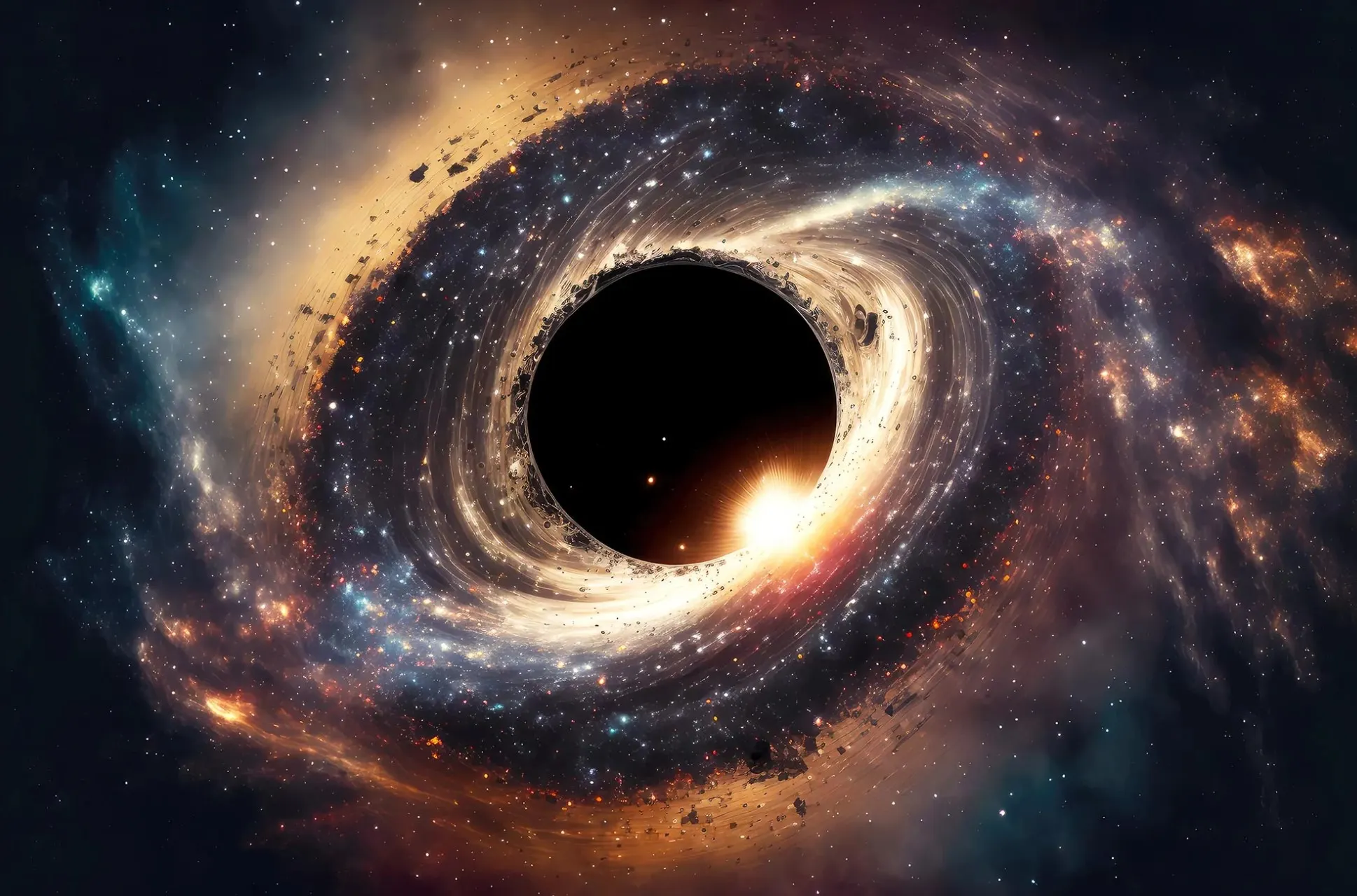
There is a place in the universe where space becomes time and time becomes space. It is not a metaphor. It is not a poetic abstraction. It is a precise, mathematical transformation that occurs at the event horizon of every black hole — a surface where the geometry of reality undergoes such a violent rearrangement that the direction you previously called “forward in time” becomes the direction you now call “inward in space,” and the direction you previously called “inward in space” becomes something you can move along as freely as you once moved through time.
This is the space-time swap, and it is one of the most disturbing predictions of general relativity. Einstein’s equations describe it with cold mathematical precision: at the Schwarzschild radius, the signs of the time and radial terms in the metric flip. What was timelike becomes spacelike, and vice versa. But the equations offer no physical explanation for why this happens. They describe the swap; they do not explain it.
The information lattice does.
The Two Heartbeats of the Vacuum
To understand what happens at a black hole, you first need to understand how the vacuum works when nothing dramatic is happening. In the information lattice framework, the vacuum is a crystalline network of octahedral voids, each hosting an 8-qubit register governed by the [8,4,4] error-correcting code. Reality advances through a walk operator — a two-stroke engine that alternates between two fundamentally different operations at every tick.
The first stroke is the coin. The CNOT gate fires on the qubit register, flipping one bit (I₃) conditional on another (χ). This is the temporal heartbeat — the tick of the clock, the moment when something happens to the particle’s internal state. Every weak interaction, every flavour change, every moment of internal evolution traces back to this gate firing. Time, on the lattice, is the CNOT.
The second stroke is the shift. Amplitude propagates along bridge edges from one void to the next, with the bridge geometry imposing a rotation on the qubit faces. This is the spatial heartbeat — the step through space, the moment when the particle moves from one location to another. Space, on the lattice, is the bridge network.
In ordinary spacetime, these two strokes alternate with metronomic regularity. Coin, shift, coin, shift. One internal tick per spatial step. The ratio of ticks to steps determines the particle’s velocity: a heavy particle (whose coin is expensive, because its frustrated codeword triggers many parity-check penalties) needs more ticks per step and moves slowly. A light particle (whose coin is cheap) needs fewer ticks and moves quickly. A massless particle needs zero internal ticks — it propagates at the bridge speed, the maximum velocity, the lattice’s speed of light.
This is ordinary physics. You can choose which direction to step (spatial freedom), but you must tick the clock (temporal obligation). You can move left or right, but you cannot stop aging.
Approaching the Horizon
Now imagine falling toward a black hole. As you approach, the vacuum around you is increasingly distorted. The massive object at the centre hosts maximally frustrated codewords — bit patterns with almost every adjacent face mismatched — and their frustration warps the surrounding void geometry through the E_g tensor mode (the graviton). The octahedral voids near the mass are squeezed on one side and stretched on the other. The bridges are no longer uniform.
Two things happen to the walk operator as the distortion deepens.
The shift becomes asymmetric. Bridges facing the mass are compressed — shorter, easier to hop across. Bridges facing away are stretched — longer, harder to traverse. Amplitude preferentially flows inward. This is gravitational attraction, experienced as a bias in the spatial step of the walk operator.
The coin becomes more expensive. The distorted void geometry increases the frustration energy landscape. The CNOT gate, which fires on specific face positions, costs more energy per tick in a distorted void because the distortion has shifted the faces relative to each other and created additional frustrated edges. Clocks run slower near massive objects because each tick of the coin costs more Boltzmann energy. This is gravitational time dilation.
So far, nothing qualitative has changed. Space is curved (the shift is biased). Time is dilated (the coin is expensive). But the walk operator still alternates between the two strokes. Coin, shift, coin, shift. The engine still has two heartbeats.
The Phase Transition
At the event horizon, the walk operator’s engine seizes.
At a specific frustration density — the critical density — the Boltzmann cost of a single coin tick exceeds the energy that one bridge hop can provide. The CNOT costs more than the shift delivers. The walk operator cannot complete a full cycle. The first heartbeat (the coin) stops.
But the walk operator must remain unitary. Amplitude must be conserved. If the coin cannot fire, the energy that was driving it must go somewhere. The only place it can go is into the shift. The temporal energy — the energy that was advancing the internal clock — gets rerouted into spatial propagation.
Outside the horizon, you had spatial freedom and temporal obligation. You could choose your direction but had to advance your clock. Inside the horizon, you have spatial obligation and temporal freedom. The redirected clock energy now drives you inward with the same inevitability that the clock previously drove you forward in time. You cannot avoid falling inward for exactly the same reason you previously couldn’t avoid aging: the energy budget of the walk operator allows no alternative. Meanwhile, your internal state still evolves — but now through the bridge rotations during spatial hops, not through the CNOT. Your internal evolution has become a spatial process rather than a temporal one.
The radial direction has become timelike. The internal evolution has become spacelike. Space and time have swapped.
This is not a smooth, gradual transition. It is a phase transition — a sharp, qualitative change in the walk operator’s structure, analogous to water freezing into ice. On one side of the horizon, the coin fires and the shift is free. On the other side, the coin is frozen and the shift is obligatory. The two regions have different causal structures because they have different walk operator structures, and the event horizon is the phase boundary between them.
The Vacuum’s Torn Pairs
Now we arrive at Hawking radiation, and the story becomes even more remarkable.
Throughout this series, we have described how the vacuum is not empty. At every void, at every tick, the walk operator creates virtual excursions — brief, ephemeral leaps of amplitude from the 48 valid codeword states into the 208 invalid states of the “Higgs sector.” These excursions come in pairs: for every bit of amplitude that leaks from valid state α into invalid state β, there is a compensating return from β back to α. The pair is created and annihilated within one tick. Energy is borrowed and repaid. Nothing real is produced. The vacuum seethes with these phantom pairs but remains empty on average.
These are the lattice’s vacuum fluctuations, and they are not abstract — they are the same virtual excursions that generate the Cabibbo angle, that dress quarks with vacuum polarisation, that mediate the correlated tunnelling producing V_cb. We have computed them. They are real features of the walk operator, with measurable consequences.
Now consider what happens to these vacuum fluctuations at the event horizon — at the phase transition where the coin freezes and the shift becomes obligatory.
A virtual pair is created on a void sitting right at the boundary. One partner — the inward partner — materialises on the inside of the horizon, in the region where the coin is frozen and the walk operator drives everything inward. The other partner — the outward partner — materialises on the outside, in the region where the coin still operates and particles can propagate freely.
In ordinary spacetime, both partners would snap back together within one tick and annihilate, repaying the borrowed energy. But at the horizon, the inward partner is caught. The walk operator on its side has undergone the phase transition. The redirected coin energy drives it inexorably inward, away from its partner. It cannot return to the horizon void because returning would mean moving outward — which, on the inside, means moving backward in time. It falls, irreversibly, toward the centre.
The outward partner is stranded. Its other half has been swallowed by the phase transition. It has no partner to annihilate against. The energy that was borrowed from the vacuum cannot be repaid by pair annihilation, because one member of the pair has been permanently separated by the horizon.
The outward partner is now a real particle. It has genuine energy, genuine momentum, and it propagates away from the black hole as freely as any other particle. It is Hawking radiation.
The Temperature of Nothing
The spectrum of Hawking radiation — which particles are emitted, and at what energies — is determined by the walk operator’s structure at the horizon.
The virtual excursions that get split by the horizon sample the full 208-dimensional invalid subspace. When the outward partner is projected back onto the valid subspace by the functioning coin operator on the outside, it can emerge as any of the 48 valid codewords. But not with equal probability. Each codeword has a different Boltzmann mass M = exp(F/(2φ)), where F is its frustration count. Light particles (low frustration, low mass) are exponentially more likely to be produced than heavy particles (high frustration, high mass). The emission probabilities follow a thermal distribution — the Boltzmann distribution — with a temperature set by the energy scale of the virtual excursions at the horizon.
This temperature is the Hawking temperature. For a black hole of mass M, it is inversely proportional to M: large black holes are cold (gentle phase transition, only the lowest-energy virtual pairs are split), small black holes are hot (steep phase transition, even high-energy pairs are split). A stellar-mass black hole has a Hawking temperature of about 60 nanokelvins — unimaginably cold, far below the cosmic microwave background, and utterly undetectable with current technology. A microscopic black hole, if one existed, would blaze with radiation and evaporate in a burst of particles.
The thermal spectrum emerges because the horizon splits virtual pairs randomly — each pair that happens to be straddling the phase boundary at the moment of creation gets torn apart, and the specific codeword that emerges on the outside is determined by the bridge rotation that happens to be active during that tick. The randomness of the bridge directions, combined with the Boltzmann weighting of the frustration energies, produces a perfect thermal spectrum with no fine-tuning.
Where the Information Goes
The deepest question about Hawking radiation is not “does it exist?” (almost all physicists believe it does) but “does it destroy information?” If a book falls into a black hole and the black hole evaporates through Hawking radiation, can you reconstruct the book from the emitted radiation? Or has the information been permanently erased — destroyed by the singularity, lost to the universe forever?
This is the black hole information paradox, and it has consumed the best minds in theoretical physics for half a century. Hawking himself initially argued that information IS destroyed — that black holes violate the fundamental law of quantum mechanics (unitarity) that says information can never be lost. He later changed his mind, but the question of exactly HOW information escapes a black hole remains one of the deepest unsolved problems in physics.
On the information lattice, the answer is architecturally clear: information cannot be destroyed because the walk operator is unitary. Every operation in the framework — the CNOT gate, the bridge rotations, the O_h permutations — is a unitary transformation. Unitary transformations are invertible. They can scramble information, encode it, redistribute it across many degrees of freedom — but they cannot erase it. The walk operator is physically incapable of losing information, in the same way that a jigsaw puzzle is physically incapable of losing pieces: no matter how thoroughly you scramble the pieces, the total number is conserved, and the picture can always be reassembled.
When a codeword falls through the horizon, its information is not erased. The codeword’s bit pattern is scrambled by successive bridge rotations (the shift operator still works inside the horizon — only the coin is frozen). Scrambling is not erasure. It is encryption. The original bit pattern is encoded in the correlations between the scrambled interior state and the emitted Hawking radiation, because the inward and outward partners of each split virtual pair are quantum-mechanically entangled. They were born from the same vacuum fluctuation, and their quantum states remain correlated even after the horizon separates them.
As the black hole evaporates — emitting Hawking radiation and losing mass with each orphaned outward partner — the entanglement between the radiation and the interior grows. When the black hole has evaporated completely, all the entanglement has been transferred to the radiation field. The radiation, viewed one particle at a time, looks random and thermal. But viewed as a complete quantum system, it is pure — it contains, encoded in subtle multi-particle correlations, every bit of information that ever fell into the black hole. The book is still there. You just need to read the correlations between the Hawking photons to decode it.
The information paradox arose because Hawking’s original calculation treated gravity classically (as a fixed spacetime background) while treating the matter quantum mechanically (as quantum fields on that background). This hybrid approach is not manifestly unitary — it allows information to fall into a classical singularity from which it cannot return. On the lattice, there is no hybrid treatment. Gravity, matter, and the vacuum are all governed by the same unitary walk operator. There is no classical singularity (the maximum frustration F = 12 is finite, giving a maximum mass density of exp(12/(2φ)) ≈ 16,000 lattice units per void — large but not infinite). There is no place for information to hide and no mechanism for it to be destroyed. The information paradox is an artefact of the continuum approximation, and it dissolves when the underlying discrete, unitary structure is taken seriously.
The Firewall That Isn’t
In 2012, four physicists (Almheiri, Marolf, Polchinski, and Sully — known as AMPS) argued that the requirement of unitarity creates a paradox of its own. If the Hawking radiation must be entangled with the black hole interior (to preserve information), and if the radiation must also be entangled with previously emitted radiation (to remain a pure state), then the radiation is entangled with two different systems simultaneously — which quantum mechanics forbids for maximally entangled states. Their proposed resolution was a “firewall” — a wall of violent energy at the event horizon that incinerates anything crossing it, breaking the entanglement by force.
The firewall proposal was deeply controversial because it contradicts the equivalence principle (which says that crossing the horizon should be uneventful for a freely falling observer) and because it seems physically absurd (the horizon of a large black hole is in nearly empty space, with negligible curvature — there is no obvious energy source for a firewall).
On the information lattice, the AMPS paradox does not arise, because the entanglement structure is different from what AMPS assumed. The key difference is that the lattice’s virtual excursions are NOT maximally entangled pairs. They are excursions through the 208-dimensional invalid subspace, which has a rich internal structure — 208 dimensions of entanglement space, not 2. The entanglement between the inward and outward partners is distributed across many degrees of freedom (all 208 invalid states participate in each virtual excursion), and distributed entanglement does not violate the monogamy constraints that drive the AMPS argument. The outward partner can be partially entangled with the interior AND partially entangled with previous radiation, because the entanglement is shared across a high-dimensional space rather than concentrated in a single qubit pair.
The horizon, on the lattice, is not a firewall. It is a phase transition — a smooth (at the lattice scale) boundary between two regions with different walk operator structures. A freely falling observer crosses it without drama, because the walk operator changes continuously from void to void (the coin cost increases gradually, not abruptly). The observer’s subjective experience is a smooth transition from “coin works normally” to “coin is increasingly expensive” to “coin can no longer fire.” At no point does anything violent happen. The phase transition is gentle, spread over many voids, and the observer’s codeword is never disrupted — it is merely redirected from temporal evolution to spatial propagation.
The Deepest Lesson
Black holes, in the standard account, are where physics breaks down. The singularity is infinite. The information paradox is unsolved. The firewall is absurd. The space-time swap is unexplained. They are the places where our theories confess their incompleteness.
On the information lattice, black holes are where the walk operator undergoes a phase transition. The singularity is replaced by a finite maximum frustration. The information paradox is resolved by unitarity. The firewall is avoided by high-dimensional entanglement. The space-time swap is explained by the coin-shift energy balance.
And the deepest lesson is this: the space-time swap is not a mysterious feature of curved geometry. It is a budget constraint. The walk operator has a fixed energy budget per tick. Outside the horizon, that budget is split between the coin (time) and the shift (space) in a ratio determined by the particle’s mass. At the horizon, the coin exhausts the entire budget, leaving nothing for the shift — or rather, requiring the shift to absorb the coin’s energy to maintain unitarity. The swap is an accounting identity, as mundane as a company reallocating funds from one department to another when the first department’s costs exceed its budget.
The universe, it turns out, is a bookkeeper. And black holes are where the books no longer balance — until you rearrange the accounts.